Kitchen Island · Architectural Sculpture · Moscow, 2026
Stone Balance The Third Stone
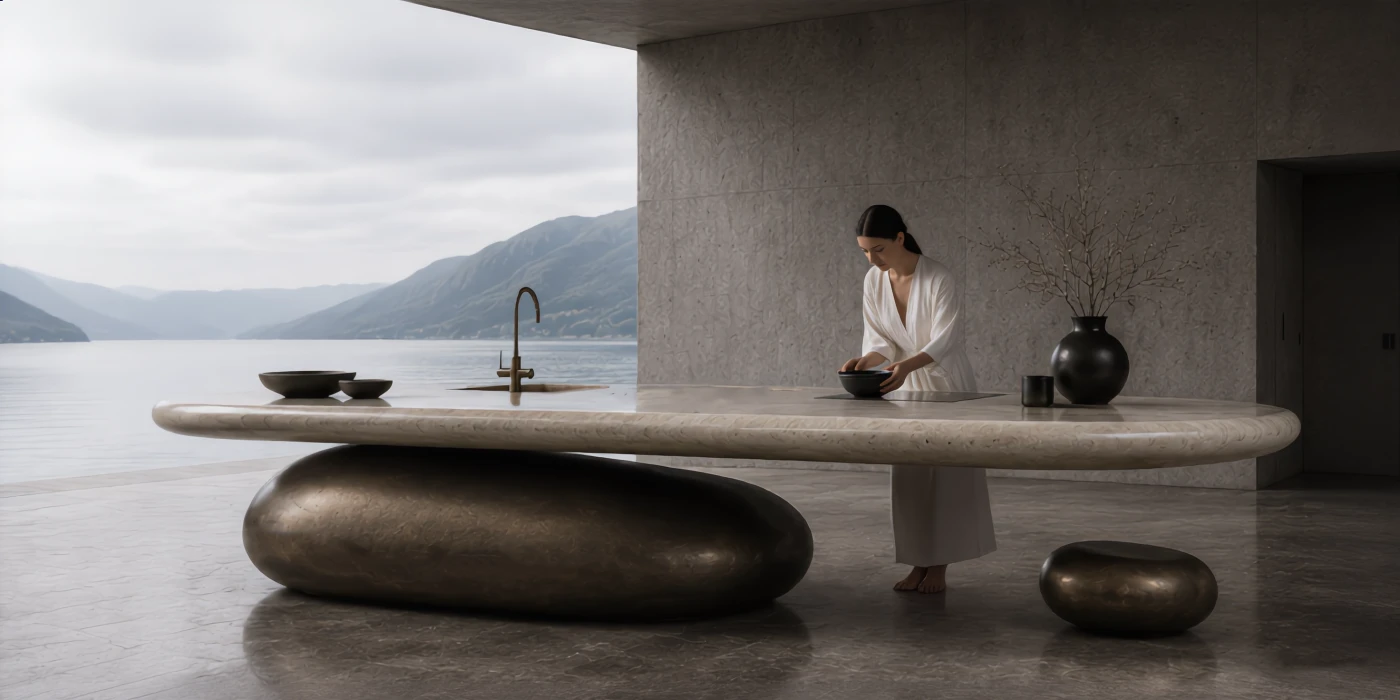
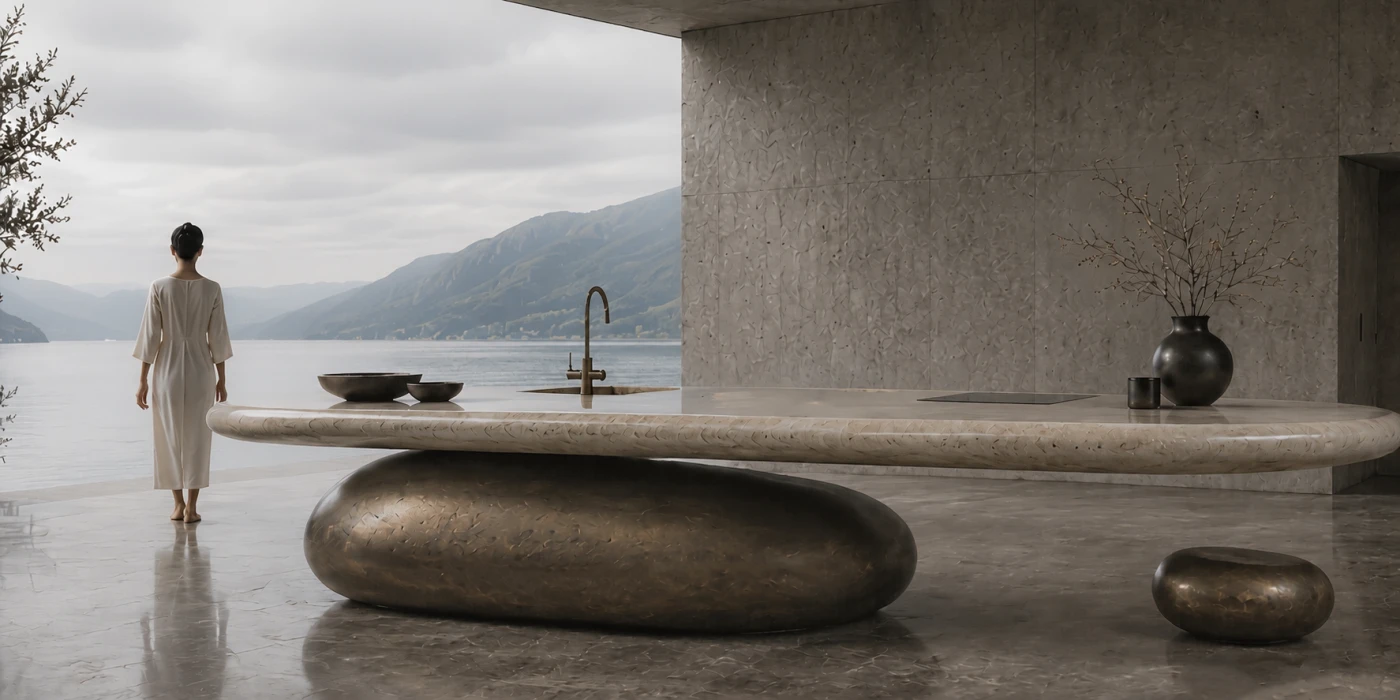
A sculptural kitchen island that transforms negative space into an architectural element — where absence becomes material.
Concept
While the composition consists of only two physical stone volumes, its conceptual centerpiece is the invisible «Third Stone» — the void between them. By treating absence as a material, the project redefines the kitchen island as an architectural sculpture rather than conventional furniture.
Inspiration
Shaped by erosion,
defined by what remains
The project was inspired by natural erosion, where water, wind and time gradually remove material instead of adding it — revealing only what is essential.
This process led to an exploration of absence as a design tool rather than a void to be filled. Research into spatial perception, structural balance and the relationship between mass and negative space shaped the concept of the invisible «Third Stone.»
Empty space becomes an active architectural element. Not a passive gap — but the subject of the composition itself.
Structure
The impossible
made inevitable
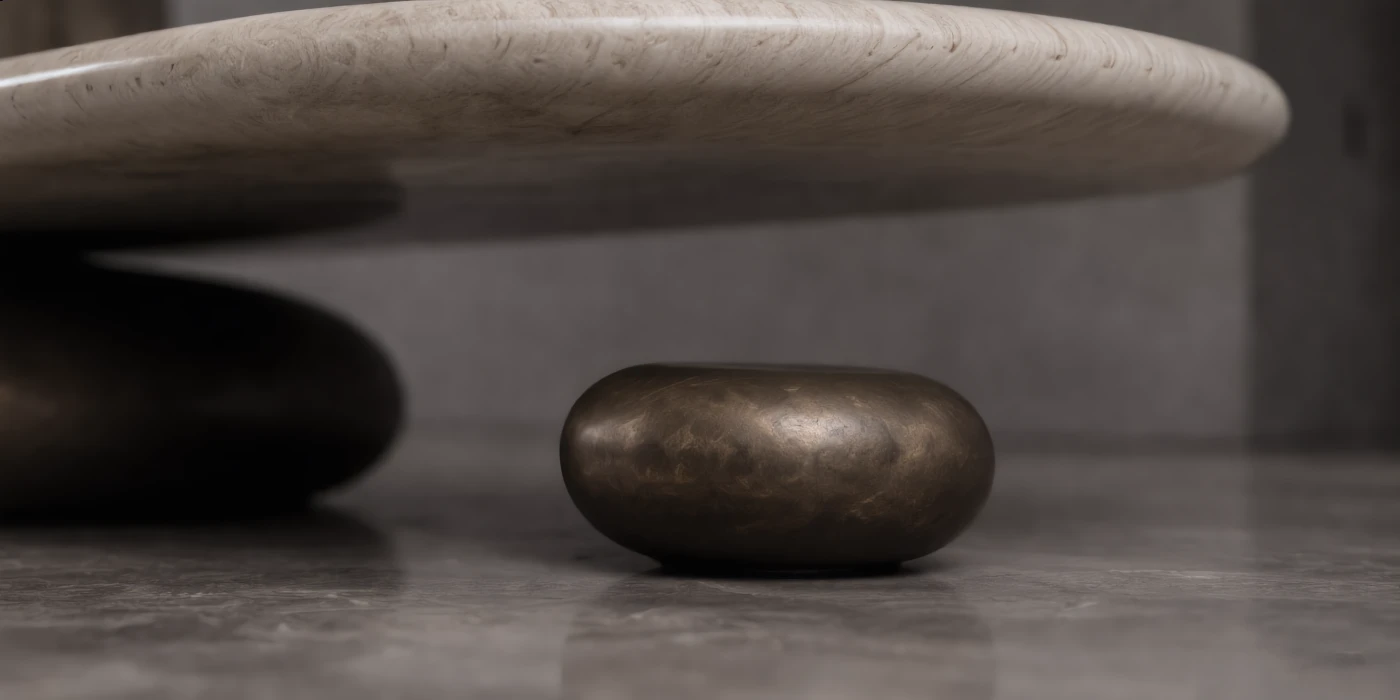
A single monolithic support carries the entire structure. The second stone volume exists solely to create visual equilibrium — it bears no load. This asymmetry is the engine of the composition.
The massive travertine slab appears to float, balanced on a single patinated bronze boulder. The cantilever extends far beyond the support point, creating a visual tension that holds the eye and questions what it sees.
Every engineering decision was developed to preserve the illusion — so that the concept of the «Third Stone» can be perceived without distraction.
Material
Where travertine
meets bronze
Natural travertine CNC-machined to a monolithic form, incorporating a concealed lightweight structural core to reduce weight while preserving the appearance of solid stone.
Patinated bronze — aged, oxidised, textured by hand — carries the warmth of geological time. The boundary between the two materials, the thin shadow line at the air gap, is the most precise moment of the object.
Both surfaces were shaped by time — one natural, one engineered to appear so.
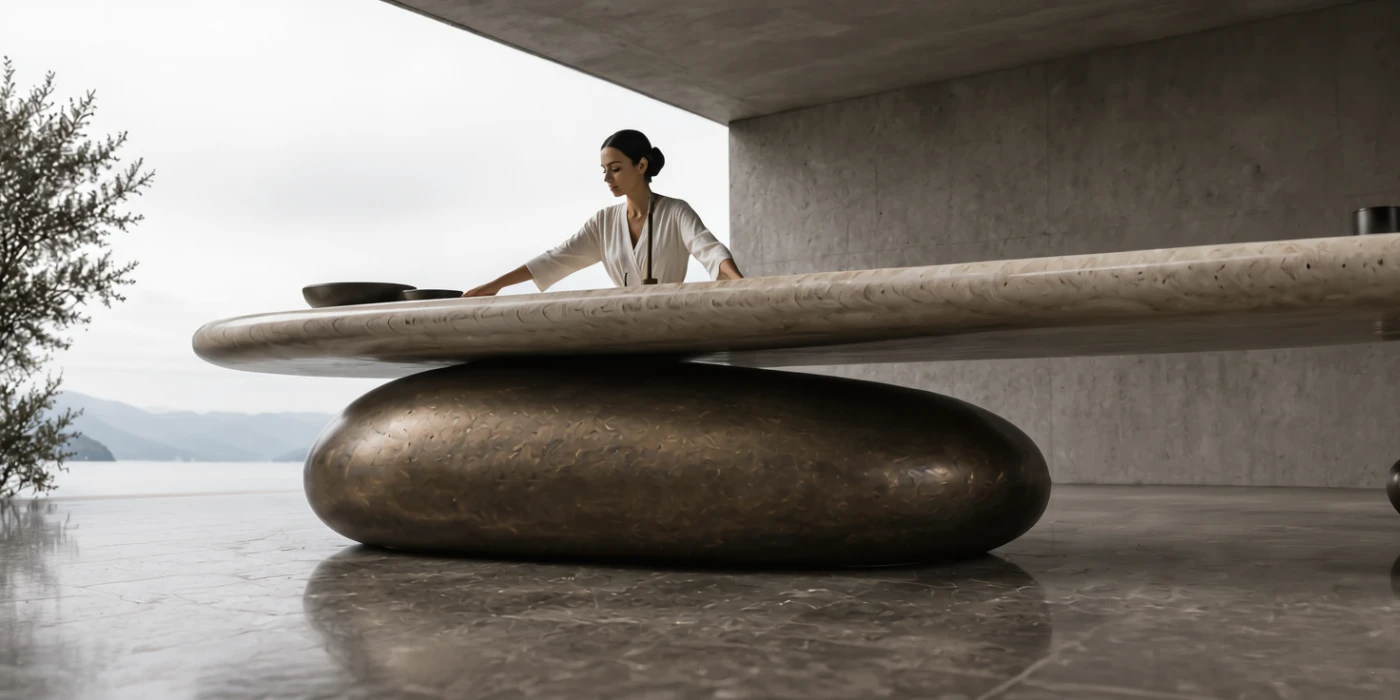
«Just as a pause defines music,
absence defines form.»
Stone Balance · The Third Stone · 2026
Specifications
Dimensions
- Overall Length3600 mm
- Depth1100 mm
- Height900 mm
- Countertop Thickness140 mm
- Estimated Weightapprox. 1100 kg
Construction
- CountertopCNC-machined natural travertine, concealed structural core
- SupportPatinated bronze — single load-bearing volume
- Third StonePatinated bronze — non-structural, visual equilibrium only
- FrameHidden steel structure, concealed floor anchoring
- ServicesIntegrated sink, plumbing, drainage, electrical — fully concealed
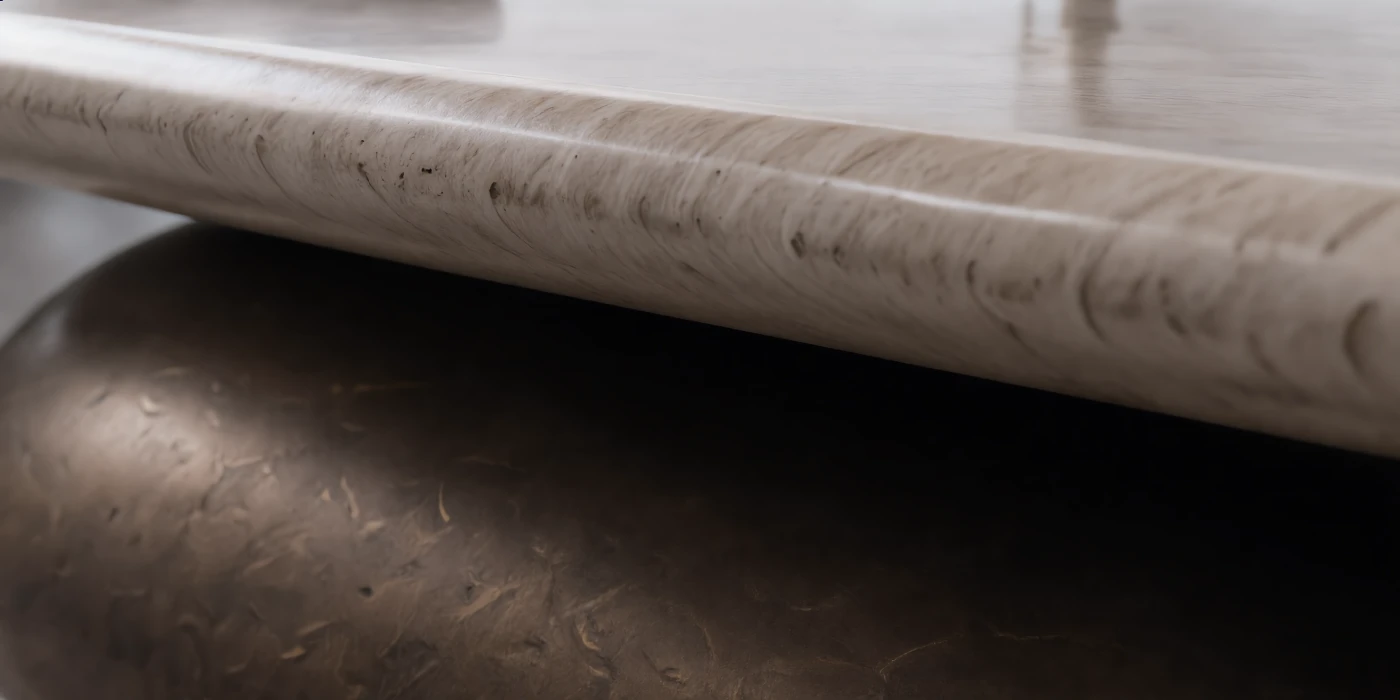
Engineering
Invisible structure,
visible intention
The support stone conceals a floor-anchored steel base plate secured with concealed anchor fixings. A concealed vertical steel tower rises through the stone and connects to the hidden structural frame within the countertop.
The junction between the vertical support and the horizontal slab is reinforced by an internal steel truss, enabling the long-span cantilever while preserving the visual illusion of a floating monolithic stone slab.
Plumbing, drainage and electrical services are fully integrated within the same concealed structural volume — leaving all technical systems completely invisible from every viewpoint.
3600
mm — total span
1
load-bearing support point
∅ 40
mm concealed steel rod
0
visible technical elements
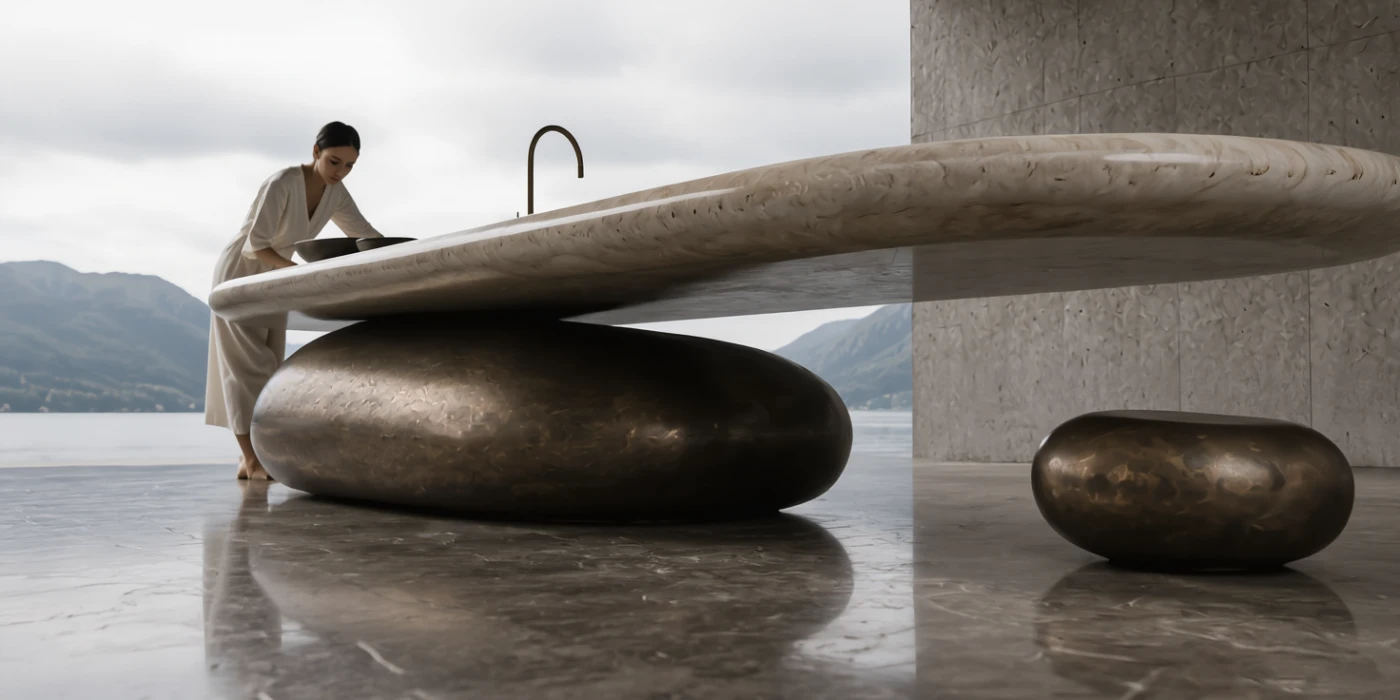
The Third Stone
Present without
touching anything
The small bronze stone sits on the floor near the right end of the island. It carries no load. It serves no structural purpose. It exists to create a visual counterweight — and to name the void.
Its presence makes the space between the two volumes legible as something. Without it, the gap is empty. With it, the gap becomes the third stone: an invisible volume held between two real ones.
Stone Balance is experienced before it is used. The composition invites the viewer to move around the object, discovering how mass, balance and empty space interact from each new angle.
Absence can possess
no less force than presence.
Kitchen Concept · Moscow · 2026